Showing posts with label Data Warehousing. Show all posts

Thursday, 14 January 2016

MSBI -- Data Warehousing Concepts -- Part-6

MSBI -- Data Warehousing Concepts -- Part-6

Dimension and Fact Table

Dimension Table:
1.     The table which stores Master data OR Organizational level data is known as Dimension table.
2.     Each record in this table gives a complete description of a particular entity.
3.     The Dimension Table data will not change frequently but over a period of time dimension table data also changes.
                 

Fact Table:
1.     The table which stores actual day-to-day business transactional data is known as Fact table.
2.     Each Record in this table is a business transaction at particular point of time.


MSBI -- Data Warehousing Concepts -- Part-5

MSBI -- Data Warehousing Concepts -- Part-5

                                    As we know that Data warehouse is nothing but a Collection of Data.
  Based on the behaviour of the data, it has been classified into two types.

Types of Data:
                            Any Organization running business has two kinds of data
1.   Master Data
2.   Transaction Data
Master Data:
                          Master data is nothing but a Organizational or High Level Data
                           For Example:
1.     Store
                                                
2.     Customer
3.     Date
4.     And Product so on….

Transactional Data:
                                   Transactional Data is nothing but a Day-to-Day business transaction details.
For Example:
1.     Each store wise Sales Amount Information.
2.     Each employee wise Salary Details.


MSBI -- Data Warehousing Concepts -- Part-4

MSBI -- Data Warehousing Concepts -- Part-4

Data Warehouse Architecture:

MSBI Architecture:


MSBI -- Data Warehousing Concepts -- Part-3

MSBI -- Data Warehousing Concepts -- Part-3

What is BI(Business Intelligence):

                               The Process of Converting Raw-data into useful information & set of tools which is used to do this, Is called Business Intelligence


Any BI Process includes two Phases:


   1.  ETL (Extract, Transform and Load):
Ø Which means Extracting data from different source systems
Ø Transforming the data by applying business logic & formatting them
Ø And finally load the data into Data warehouse
Different ETL Tools in the Market:
·        SSIS(SQL Server Integration Services)
·        Informatica
·        Data Stage
·        Abinitio
   2.  Reporting and Analysis Phase:
             Once the data is ready in the Data Warehouse tables, then we can generate the reports by reading the data from DWH Data.
Different Reporting & Analytic Tools in the Market:
·        SSRS(SQL Server Reporting Services)
·        SSAS(SQL Server Analysis Services)
·        Tableau
·        Cognos
·        Excel
·        Business Objects.


MSBI -- Data Warehousing Concepts -- Part-2

MSBI -- Data Warehousing Concepts -- Part-2

Why Data Warehouse:

§  Now-a-days most of the Organizations were suffering lack of information even they had a huge amount of Raw-Data.


§  With the current competitions, in order to get success in their business, they need to analyse their own business trends, by converting the raw-data which is not properly formatted into useful information.

§  As a process of it, Collect the data from different source systems & Convert into useful format & put it in a common place, which is nothing but a Data Warehouse.

§  Using the Data Warehousing data,we can generate useful information interns of Reports & Dashboards.


Sunday, 10 January 2016

MSBI -- Data Warehousing Concepts -- Part-1

MSBI -- Data Warehousing Concepts -- Part-1

What is Data Warehousing:

             A Data Warehouse is 
1.     Subject-Oriented
2.     Integrated
3.     Time-Variant
4.     Non-Volatile 
                                        Collection of Data, which is used for effective decision making of organisations High & Middle Level Management.

1.   Subject-Oriented: 
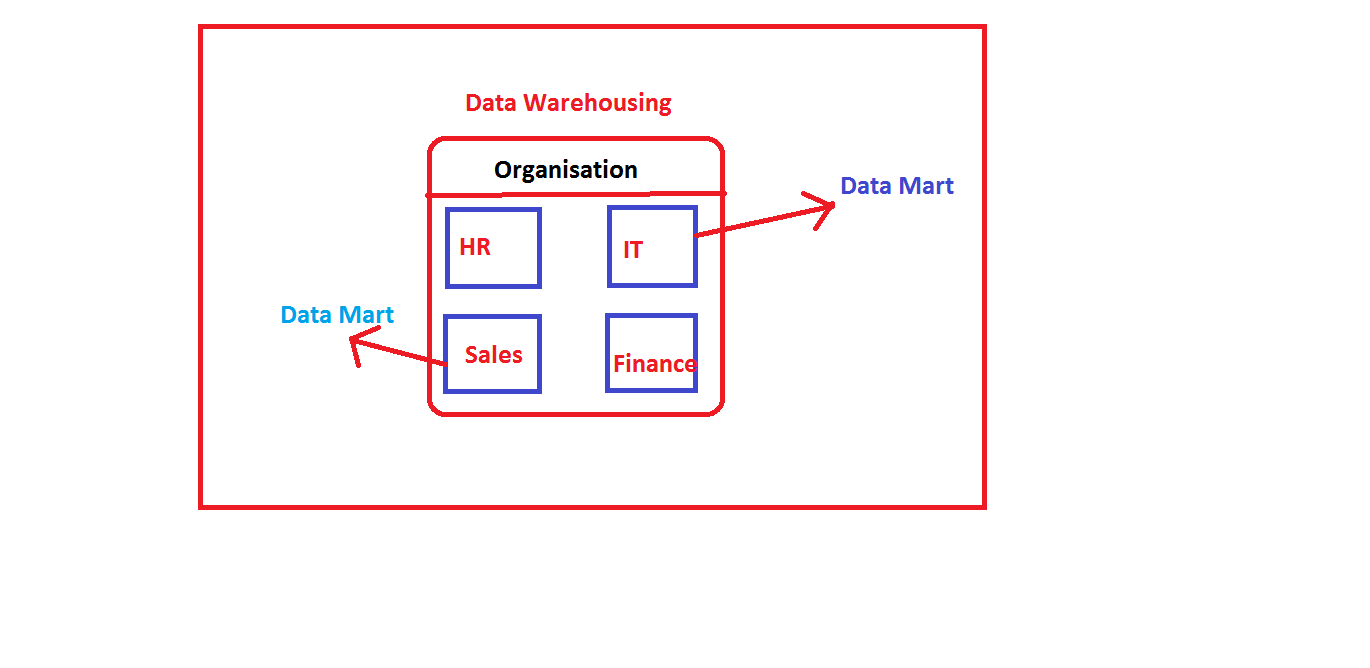
                              In Data Warehouse we can store each subject related data separately in terms of Data marts.
DataMart: 
                     DataMart is a subset of Data Warehouse which deals with particular Department data.
2.   Integrated: 
                              Data Warehouse data is Integrated data from multiple source systems.
3.   Time Variant: 
                              Historical It is not possible to take Analysis with referring time.
Each Record in Data Warehouse will be related to particular point of time.
4.   Non-Volatile: 
                                  The Data Present in Data Warehouse is Non-Editable.